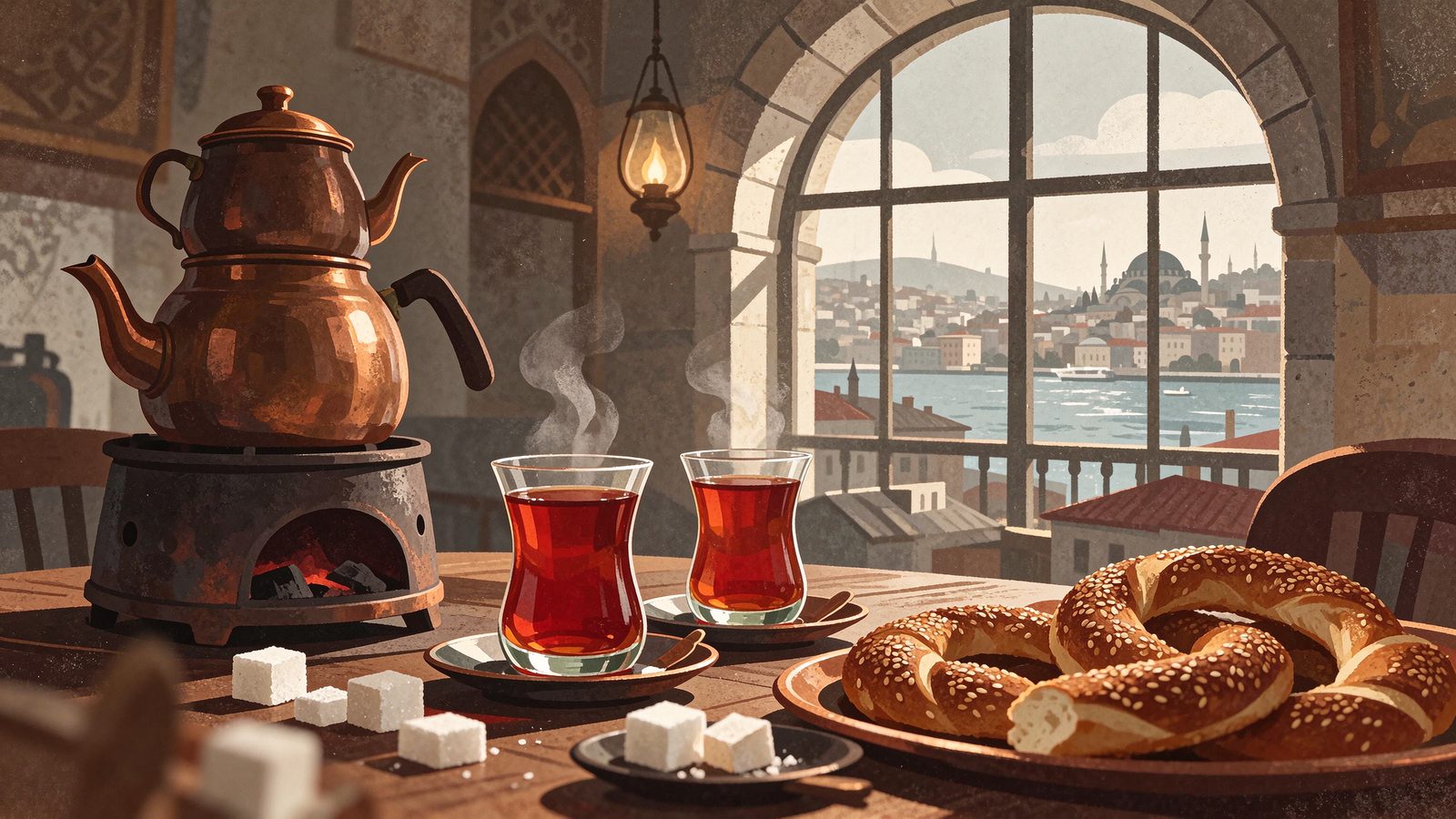
Turkish tea (çay) is Turkey's most consumed drink and a fixed gesture of hospitality, weddings, breakfast and office breaks. It centres on Rize and the eastern Black Sea, brews in a double teapot (çaydanlık), and is served in a tulip-shaped glass with sugar cubes. It is not the “apple tea” sold to tourists, which is usually a herbal-fruit instant drink, not true tea.
Origin and identity
Tea growing is concentrated in the eastern Black Sea, with Rize at the core. Locals call tea “green gold”; the industry anchors the regional economy, and weddings and circumcision celebrations are often scheduled after the harvest so relatives can attend. Turkey's Ministry of Culture describes tea culture as the knowledge, skills and traditions of growing, preparing, serving and drinking tea, and identifies black tea as the most consumed and harvested type.
Turkish tea is black tea, not green or herbal. Its identity is not one cultivar but a brewing system: the upper small pot holds leaf and boiling water to make strong tea (dem); the lower large pot holds boiling water. To serve, strong tea goes into the glass first, then hot water dilutes it to taste. Strength is each drinker's choice — the basic freedom of the Turkish tea table.
Vessels and scenes
The tulip-shaped glass (ince belli bardak) is the signature: a narrow waist for holding, a transparent body to show colour, a small volume for refills. Tray, sugar cubes, spoons and teapot complete the set. Sugar is often placed on the tongue or held in the mouth before a sip; others stir it into the glass.
Tea appears at breakfast, mid-afternoon, in offices, shops, barbers, bus stations and home hospitality. Offering tea is basic courtesy; accepting or declining carries social meaning, and in a shop a glass often arrives before the transaction. Tea gardens (çay bahçesi) and old coffeehouses (kahvehane) are important social spaces; women increasingly use them too.
History
Turkey's tea industry is part of 20th-century nation-building. In the late Ottoman period coffee was expensive and trade-dependent, and tea was promoted as an alternative; in the Republic, gardens and state factories were established in Rize and elsewhere, and tea became a national drink. This is not an “ancient tradition” but a modern industry shaped by markets, state policy and regional agriculture.
After the 1980s private factories multiplied and consumption expanded; Turkey is now a major producer and among the world's highest per-capita tea consumers. Calling Turkish tea “Middle Eastern tea” is inaccurate: it belongs to the humid Black Sea coast, distinct from Arab and Persian tea customs.
Brewing and boundaries
Standard method: 2–3 tbsp black tea in the upper pot, boiling water, steep 5–10 minutes; keep the lower pot boiling. Fill the glass one-third with strong tea, top with hot water to eight-tenths, add sugar. Too strong, add water; too weak, use less water. Shorten the second steep to avoid bitterness.
Turkish tea is not “apple tea”; apple tea (elma çayı) is a tourist-market fruit drink, usually without tea. It is not “the stronger the better”: strength is personal, and excess is astringent. The double pot is not the only method — homes use ordinary pots — and the tulip glass is a cultural sign, not a legal requirement.