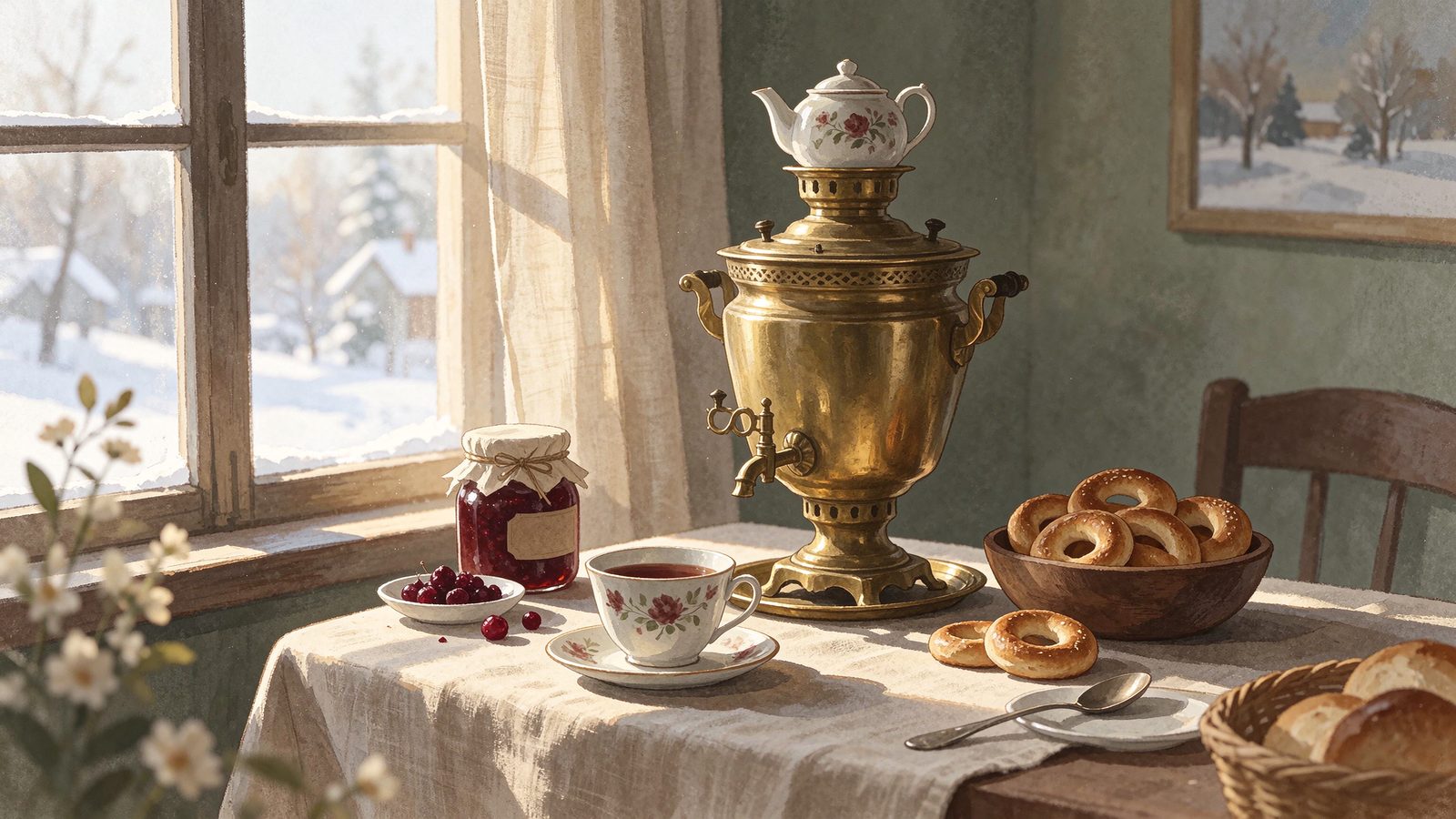
The Russian samovar is a water heater and the centre of hospitality, not a teapot. A firebox or electric element sits inside; water boils in the body. Strong tea (zavarka) is brewed separately in a small teapot, then diluted with hot water from the samovar. Treating a samovar as a “Russian teapot” misunderstands both its function and its ritual.
Object and function
The State Historical Museum defines it plainly: a metal vessel for boiling water with a firebox inside. The first Russian samovars appeared in the first half of the 18th century; the earliest documentary mention is 1740. The first makers were Urals factories — the Osokins at Irginsky and the Demidovs at Suksun. It began as a noble household item; as tea became cheaper in the 19th century it entered all classes and became a symbol of prosperity, warmth and hospitality.
Structurally it has a water body, inner firebox/flue, bottom draft, top teapot rest, tap and handles. Charcoal goes in from the top and heats the water; the tap draws hot water. Fine samovars use copper, brass, silver or porcelain decoration, from barrel and vase shapes to Empire style. The museum holds 354 samovars and water heaters, evidence that it was decorative art as well as kitchen equipment.
Tea custom and scenes
The typical Russian gesture is tea “around the samovar”: family gatherings, guests, railway stations, tea houses, summer dachas and gardens. A large samovar signalled a large household's prosperity; peasant families treated it as one of their most valuable possessions. In the 20th century electric kettles replaced it, but the custom still centres on heat, slowness and company.
Russian tea usually takes sugar, lemon, jam or honey; sugar can be held in the mouth (vprikusku) or put in the glass. Glasses often sit in metal holders (podstakannik) for heat and display; the pot of strong tea is zavarka, while the samovar only supplies hot water. This “strong tea + hot water” layering is the key difference from English pot brewing.
History
Tea entered Russia in the 17th century via Mongol and Siberian caravans; in 1638 it reached Tsar Mikhail Fyodorovich as a gift and later became a court and urban drink. In the 17th–19th centuries the Kyakhta border trade brought Chinese brick and loose tea; in the 19th century railways and shipping expanded supply and tea reached ordinary households. Samovar use grew alongside falling prices and urbanisation.
“The samovar is ancient Russia” is inaccurate: it is an 18th-century product tied to Urals metalworking and the tea trade. It is not “for boiling tea”: it boils water, and the leaf brews in a pot; the water is heated, not the leaf.
Brewing and boundaries
Home method: 4–5 tbsp black tea in a teapot, boiling water, steep 5–10 minutes for zavarka; fill a glass one-third with strong tea, top with hot water from the samovar, add sugar, lemon or jam. For a second glass, use less zavarka. Without a samovar, an electric kettle and ordinary pot reproduce the logic.
A samovar is not a teapot, and not a synonym for “Russian black tea”; it is a water heater. Russian tea is not one tea type but a method of diluting strong tea and adding sugar or lemon. Decoration and size are not quality; treating the samovar as a mere antique ignores its continued use in some homes and tea houses.