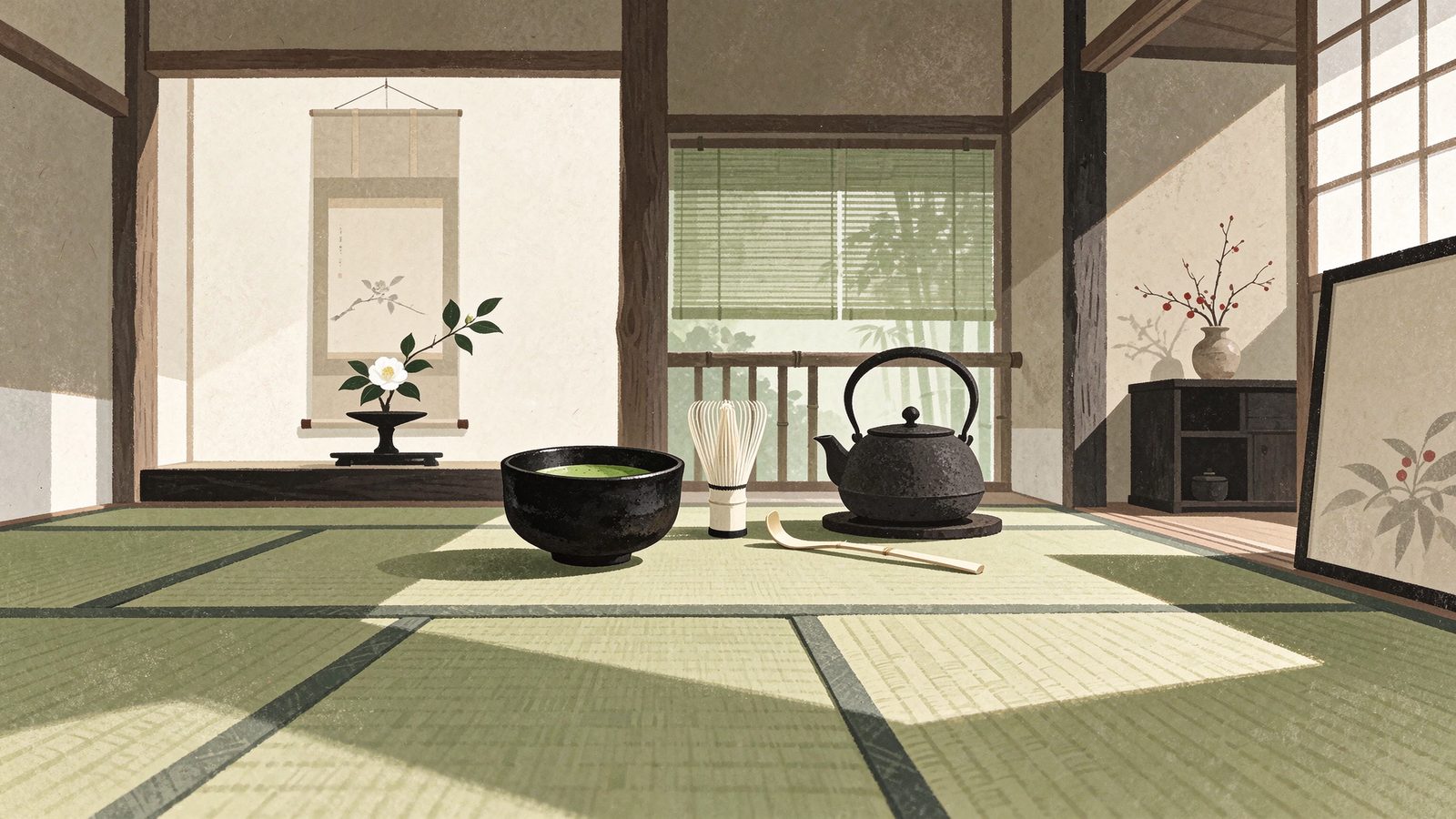
Japanese chanoyu (the Way of Tea) is a composite art centred on matcha, performed in a tea room for guests. Sen Rikyu established the wabi aesthetic in the 16th century and set out wa, kei, sei, jaku — harmony, respect, purity, tranquillity. It is not just “whisking a bowl of matcha”: the tea room, hanging scroll, flower, charcoal, kaiseki meal and host-guest etiquette are all part of it, and the schools differ greatly.
From drinking tea to a “way”
Tea entered Japan from China and spread among temples and nobles in the Heian and Kamakura periods; Eisai's Treatise on Tea and Health linked tea to health and Zen practice. In the Muromachi period, shoguns and nobles turned tea gatherings into displays of utensils and status. In the 16th century Sen Rikyu shrank the gathering to a grass-hut tea room, emphasising simplicity, imperfection and natural materials — wabi.
Rikyu's tea room was as small as two mats (Taian, still at Myokian); the entrance was low, so even a samurai had to bow. He used Raku bowls, bamboo scoops and bamboo lid rests, turning tea from an “expensive object display” into a space where people meet. In 1585 he served tea to Emperor Ogimachi and received the lay name Rikyu. In 1591, after conflict with Toyotomi Hideyoshi, he was ordered to die, but his disciples and family carried the Way forward.
Structure of a tea gathering
A formal chaji often includes: guests enter, view the room and scroll/flower, taste kaiseki, charcoal ceremony, thick tea (koicha), thin tea (usucha), appreciation of utensils and farewell. Not every gathering is complete; daily practice may only make usucha. The sequence is not a performance for guests but a way for host and guest to focus together in a small space.
The tea room (chashitsu) uses wood, bamboo, paper and earth; the tokonoma holds one scroll or one branch, chosen for season and theme, never competing with the tea. Matcha is whisked with a chasen in a bowl; koicha uses more powder and less water, usucha less powder and more water. Bowl, caddy, scoop, whisk, water jar and kettle each have a place and order.
Schools and spirit
After Rikyu, the Sen family split into Omotesenke, Urasenke and Mushakojisenke; Urasenke descends from Sotan's fourth son, Senso Soshitsu, and became one of the largest schools. Urasenke founded its foundation in 1949 and spread the practice abroad in the 20th century. Schools differ in procedure, utensils, dress and room details, but share wa, kei, sei, jaku: harmony, respect, purity, tranquillity.
Chanoyu is not a “Japanese religious rite,” nor “an elegant class only for women.” It has strict lineage and practice, and a social function; modern practice includes corporate retreats, cultural tourism, school courses and home practice. Treating it as “wear a kimono and take a photo” misses the space, time and host-guest relationship.
Brewing and boundaries
Matcha is not made with boiling water: 70–80°C, 1–2 g powder to 60–70 ml water, first paste with the whisk, then whisk to fine foam. Usucha uses less powder and more water; koicha more powder and less water. Warm the bowl, rinse the whisk; fine foam and fresh green colour are craft signals, not “the more foam the better.”
Chanoyu is not a synonym for “whisking matcha”; the room, scroll, flower, charcoal, kaiseki and etiquette are the whole. It is not all of “Japanese tea”: Japan also has sencha, gyokuro, hojicha and genmaicha. No school is the only “authentic” one; treating Urasenke procedure as the national standard ignores Omotesenke, Mushakojisenke and others.