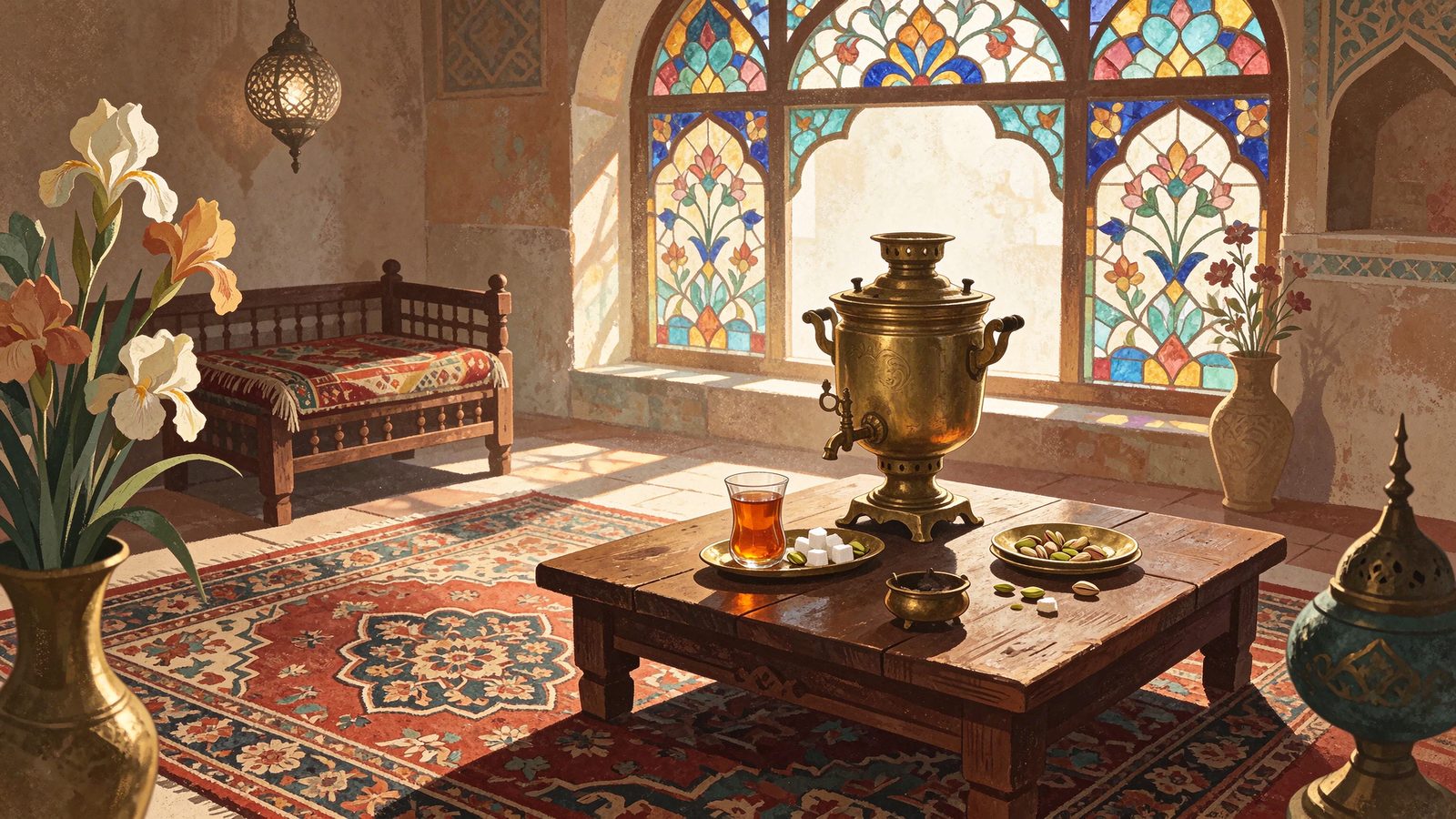
Iranian tea culture centres on the Lahijan–Gilan tea district along the Caspian coast. Black tea is brewed in a samovar or teapot, served in small glasses (estekan) with sugar cubes, dates, nuts and sweets. Tea is an everyday drink, and the tea house (chaykhaneh) is an important social space. Iranian tea is a combination of origin and drinking method, not “Persian spiced tea.”
Origin and identity
Iran's tea grows in the Caspian provinces, the only region with enough rain, drainage and slightly acidic soil. Encyclopaedia Iranica places the gardens on Alborz foothills or old alluvial terraces unfit for rice, concentrated in Gilan's Lahijan, Langarud and Rudsar, which account for about 75% of planted area. Gardens often sit on steep slopes above rice fields, with citrus orchards interwoven in the east.
Iranian tea is black tea, not green. The traditional process is picking, withering, rolling, fermentation, drying and sorting; the liquor is strong and dark, with woody and fruity aroma and a firm body. Lahijan tea is known for “pungency and aroma” and is the everyday favourite. Calling Iranian tea “black tea with saffron or rose water” mistakes a flavoured drink for the origin tea.
History
Local tea growing started late. In 1902 Haji Mohammad Mirza Kashef al-Saltaneh, then Iranian consul in India, brought back about 3,000 Assamese tea seedlings and established Iran's first plantations in Lahijan; in 1932 the first tea factory opened there. The foothills gradually filled with tea, and Lahijan became the byname of Iranian tea.
Before that, Iran imported most of its tea through Turkish, Russian and Caucasian trade, and tea gradually displaced some coffee. In the 20th century the state promoted local growing to reduce imports. Iranian tea is not “ancient”; it is a modern industry shaped by trade, colonial knowledge, state policy and a suitable climate.
Vessels and scenes
The samovar sits at the centre of a tea house or home, with a tap for hot water; a teapot holds strong tea, and the glass is filled with strong tea first, then hot water. Small glasses (estekan) sit on saucers, sugar cubes (ghand) beside them; many hold the sugar in the mouth while drinking, or add dates, raisins, nuts or sweets. The chaykhaneh serves tea, water pipe and conversation, traditionally a male space, now increasingly open to women.
Tea is the first act of hospitality: guests are offered tea before business, and tea appears at negotiations, funerals, weddings and family gatherings. It is not a “drink option” but a medium of social relations. Treating the tea house as tourist performance ignores its community function.
Brewing and boundaries
Home method: 5–6 g leaf to 200 ml, 90–95°C, 4–6 minutes; keep hot water in the samovar or double pot and dilute to taste. Strong tea can take sugar, dates or lemon; avoid long boiling, which turns bitter. Warm the pot; hard water flattens the aroma.
Iranian tea is not a synonym for “spiced tea”; saffron, rose water and cardamom are optional flavourings, not an origin standard. It is not “the stronger the better”: strength is a daily preference, and excess is astringent. The samovar is a water heater, not a teapot; reducing Iranian tea to the samovar misses the leaf.