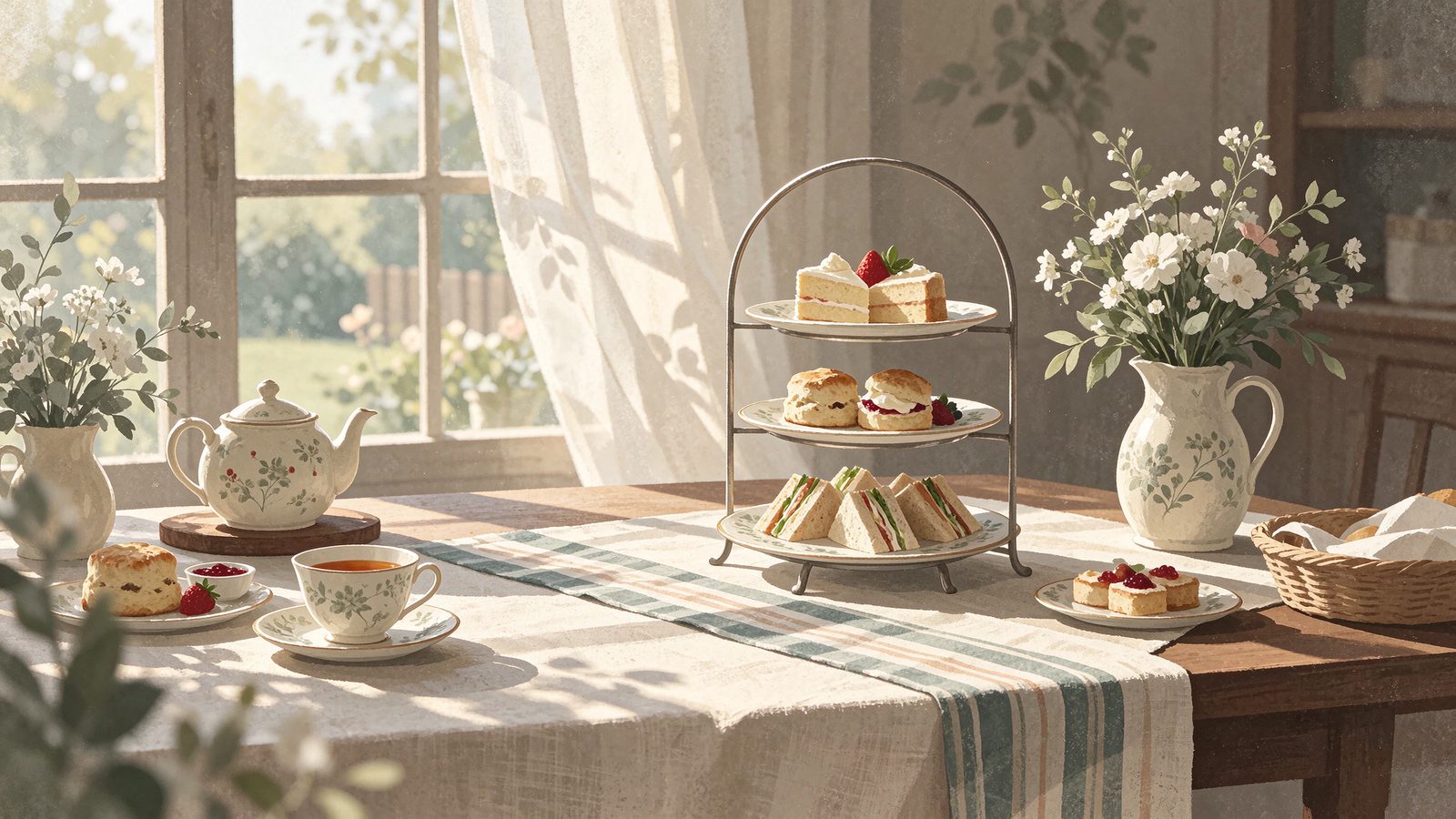
British afternoon tea usually means the late-afternoon social meal that took shape in the 19th century: tea, sandwiches, scones, cakes and sweets, arranged from savoury to sweet. It is not the same as “high tea,” the working-class evening main meal; mixing the two confuses both class and timing.
A social meal, not just tea
The UK Tea & Infusions Association traces afternoon tea to 17th-century ladies' tea parties, which became a national custom in the 18th century. Tradition credits Anna Maria, wife of the 7th Duke of Bedford: around 1841 she drank tea and ate a little food between lunch (about 1 pm) and dinner (about 7 pm), then invited guests at five. The story has a legendary edge, but it explains why afternoon tea filled a gap between meals.
By the 1860s the fashion was widespread. Tea was served in the best china, with food on small plates: bread and butter, scones, cakes, crustless sandwiches. Hotels now turn it into a three-tier stand; home versions are much simpler. The usual order is sandwiches at the bottom, scones in the middle, sweets on top — savoury before sweet, a tasting logic rather than a rigid law.
High tea is not “premium afternoon tea”
High tea was historically the working and farming family's evening main meal: meat, bread and cakes, with hot tea, at a high table — hence “high.” It belongs to a different social setting from the drawing-room afternoon tea. Calling high tea a “fancier” afternoon tea reverses the word's social history.
Afternoon tea is not “just tea.” It is a light meal; tea is the social trigger, while food, vessels, conversation and seating matter too. Hotel afternoon tea has a commercial performance element and is not the same as a 19th-century household routine. A home afternoon tea can be one pot and one cake, with no tiered stand.
Tea and vessels
Afternoon tea usually uses black tea: Assam for strength with milk, Ceylon for a bright plain cup, English breakfast and Earl Grey as common blends. Teapot, strainer, cup, saucer and cake stand create a visual order. Warm the pot, use enough leaf, steep 3–4 minutes, and avoid a thin or bitter brew.
Milk first or tea first was debated in Britain. Old porcelain feared thermal shock, so a little cold milk first could buffer it; modern cups are more resistant, and the order is mostly habit. Clotted cream or jam first on a scone also varies between Cornwall and Devon. These are regional and household habits, not one national rule.
Brewing and boundaries
Brew black tea at 90–95°C, 3 g to 200 ml, for 3–4 minutes; with milk, shorten to 3 minutes so milk and astringency do not stack. The second infusion can take another half-minute. Too weak, the milk tastes watery; too strong, the tea overwhelms the cakes.
“Afternoon tea” is a social form, not a tea grade; a three-tier stand does not mean better tea. High tea is a working-class evening meal, not a luxury afternoon tea. Treating a hotel afternoon tea as everyday British life ignores home versions, regions and class.