Cha Lu is a Northern Song tea book by Cai Xiang (1012–1067), presented to Emperor Renzong around the 1050s. Cai served as Fujian transport commissioner, supervised Beiyuan tribute tea and created the Small Dragon Tribute cake. The book has two parts: the first treats colour, fragrance, taste, storage, roasting, grinding, sieving, water, warming the bowl and whisking; the second treats utensils. It fills gaps left by Lu Yu's Classic of Tea (which did not rank Jian'an tea) and Ding Wei's Tea Illustrated (which discussed production but not brewing), and is a core technical text of Song whisked tea.
Why it was written
In the preface Cai says the emperor praised the fine dragon tea he had sent as Fujian commissioner; he reflected that a small plant, once noticed by the emperor, could “fully express its nature if placed in the right ground.” Lu Yu's Classic did not rank Jian'an tea, and Ding Wei's Illustrated discussed picking and production but not brewing. So Cai set out “several matters, simple and clear” in two parts, called Record of Tea.
Three things follow: first, Jian'an (modern Jian'ou, Fujian) Beiyuan tribute tea had become a court standard in the Northern Song; second, the book fills a gap rather than repeating the Classic; third, it is aimed at brewing practice, not a tea-mountain travelogue. Calling it “one more Song tea book” underrates its technical status.
Part one: tea, water, fire, bowl
The first part centres on colour, fragrance and taste. Cai says “tea colour values white”; cake tea was often coated with precious oils, producing blue, yellow, purple or black differences. A good judge, like a physiognomist reading complexion, looks “inward” and prizes a moist, glossy interior. This “white” is the Song whisked-tea standard, not modern green tea; it cannot be transplanted directly.
“Fragrance” says tea has true fragrance; tribute tea added a little borneol “to help” it, but Jian'an commoners did not add incense “for fear of stealing the true.” At brewing, adding fruits, flowers or aromatic herbs steals even more, “so it should not be used.” This is one of the earliest clear statements against masking tea with aromatics. “Taste” says tea is mainly sweet and smooth; Beiyuan's Phoenix Mountain is best, while acrostic mountains, even with timely manufacture, are heavier in colour and taste.
“Storage” says tea likes bamboo leaves and fears aromatics, prefers warm dryness to damp cold; families wrap it in bamboo leaves and put it in a gentle roast every two or three days, with fire “about human body temperature”; too much fire scorches it. “Roasting” revives old tea by rinsing with boiling water and scraping off oil; “grinding” and “sieving” control powder; “water” judges the boil; “warming the bowl” preheats; “whisking” makes paste, adds water and beats. Each step has an operational standard.
Part two: utensils
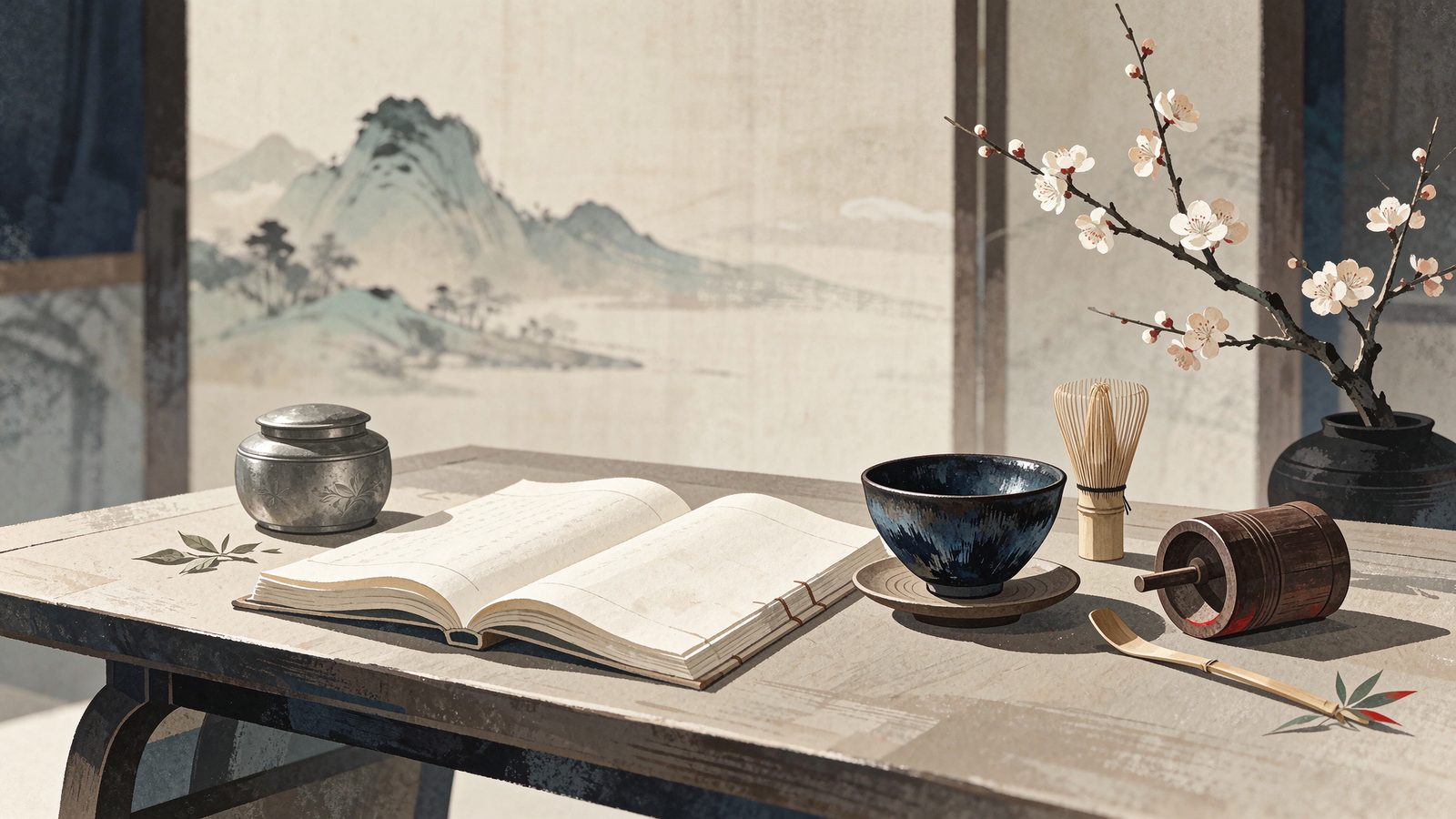
The second part covers the roast basket, tea cage, anvil and mallet, tea tongs, grinder, sieve, bowl, spoon and water bottle. The roast basket gently revives tea, the cage airs it, the anvil breaks cakes, the tongs hold them, the grinder and sieve control powder, the bowl is warmed, the spoon whisks, the bottle controls the pour. The order is not display but the sequence of whisking.
The most famous entry is the bowl: Cai says tea is white, so black bowls suit it; Jian'an ware is dark purple-black with hare's-fur streaks, a slightly thick body that stays hot after warming, and is “most needed.” Bowls from elsewhere, thin or purple, do not compare. This judgement is confirmed by Jian hare's-fur bowls: dark glaze sets off white foam, thick body holds heat. The Met's 11th–12th-century Jian bowl is exactly this type.
Editions and boundaries
Cha Lu survives in calligraphy, stone and printed editions; Cai himself wrote it in small regular script, and the Ming Duanming Ji printed it in juan 35. Wording and section order vary, so check the base text before quoting. It describes Northern Song court and Beiyuan tribute tea, not a universal manual for modern loose leaf.
It is not evidence that “all Song tea people worked this way”; it reflects Cai, Beiyuan tribute tea and court taste. Nor is it a simple “earliest record of white tea”: “tea colour values white” refers to whisked foam, not the modern white-tea category.