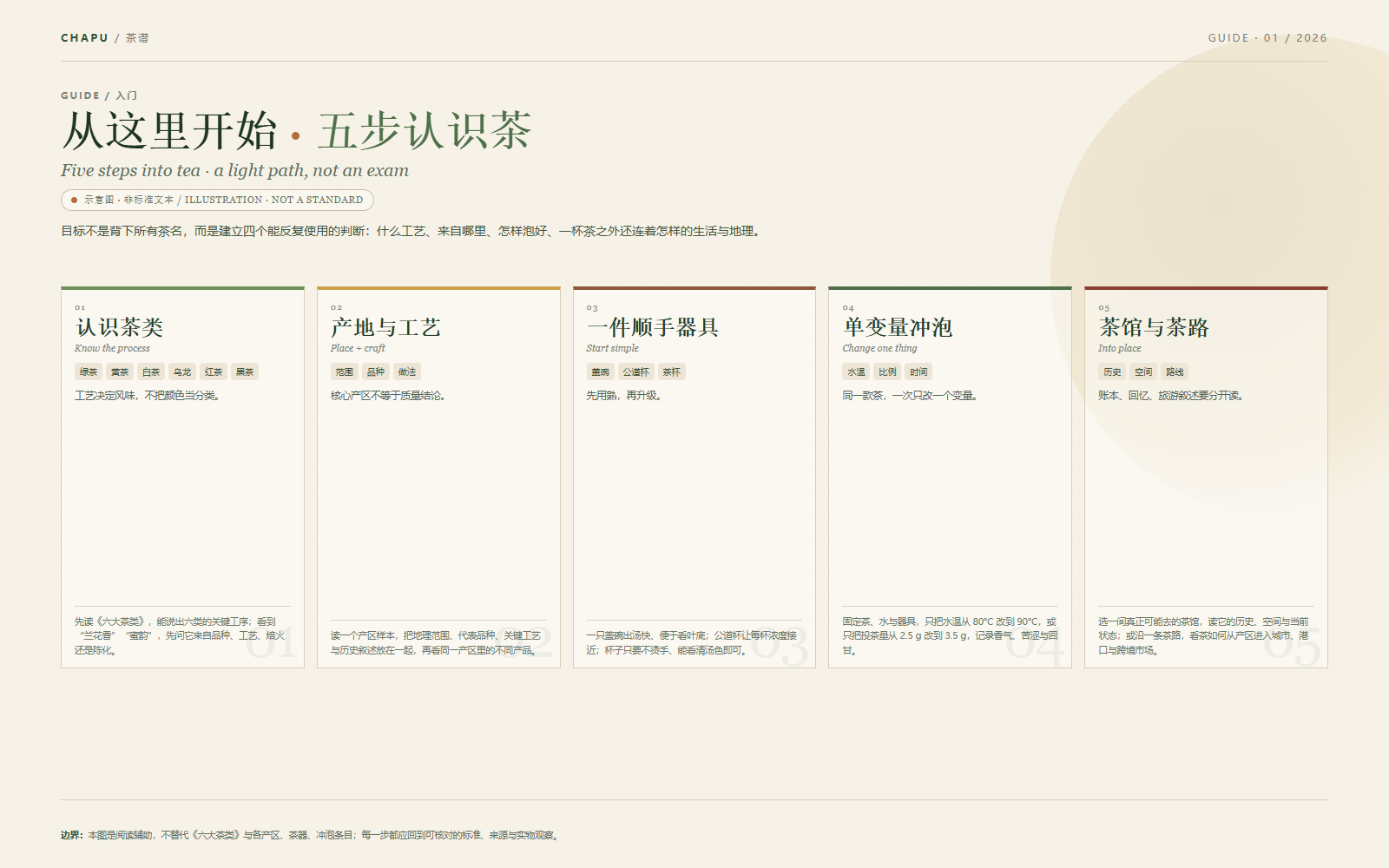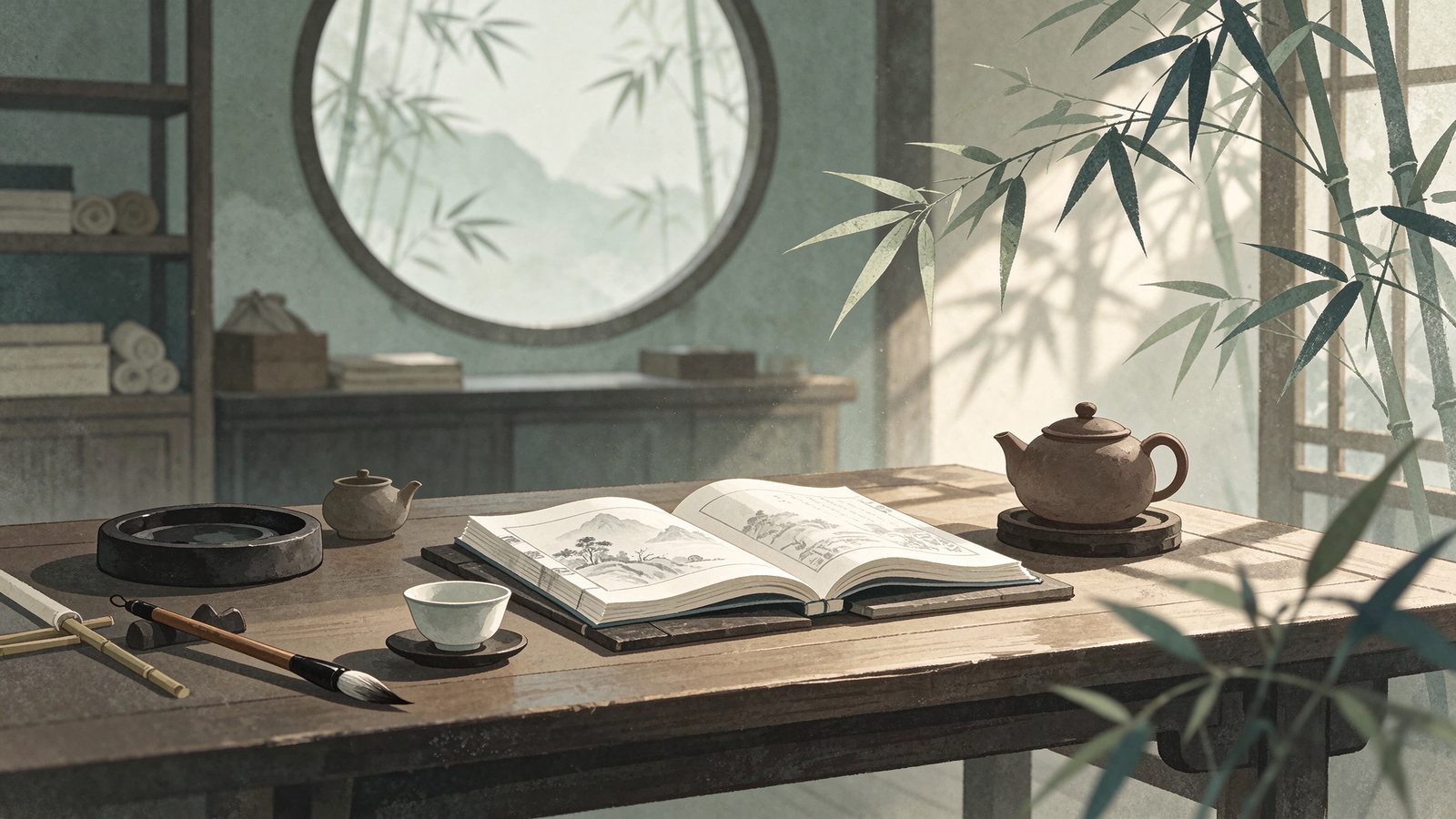
Cha Shu is a Ming tea book by Xu Cishu (1549–1604), completed in 1597. Xu, courtesy name Ranming, sobriquet Nanhua, was a Hangzhou native who loved tea and water-tasting and studied under Yao Shaoxian of Wuxing. The book has thirty-nine sections and is a practical manual from the age when loose-leaf tea had become mainstream. It stands beside Lu Yu's Classic of Tea, but its technical parameters carry late-Ming limits.
A late-Ming tea book
Cha Shu was written in the twenty-fifth year of the Wanli reign (1597). Yao Shaoxian's preface says Xu “got the principles of tea most deeply” and wrote the book; in 1607 Xu Caifu brought the manuscript to Yao for a preface. The publication history shows the book was edited and issued by friends after the author's death, not a fixed lifetime edition.
The Siku Quanshu Zongmu Tiyao lists it and says the thirty-nine sections discuss picking, storage and brewing in detail, while criticising the “water selection” section for mistaking a well on top of Mount Jin for the Zhongling spring. The judgement is useful: it recognises the technical value and warns that geographical and water claims may be wrong.
What to read
Cha Shu covers tea production, picking, pan-firing, storage, water selection, brewing, utensils, drinking, setting and travel. It asks: what tea is good, when to pick, how to fire, how to store, what water, how to brew, where to drink. “Pan-firing” discusses wok temperature and hand movement; “storage” discusses bamboo leaves, roasting and humidity; “water” discusses springs and water quality; “tea setting” discusses the space of drinking.
Its value is the operational sequence: pick, make, store, boil, drink. Readers can use its fire, utensil and water advice as a checklist, not a fixed recipe. For example, pan-firing should be half-done, fast, and never scorched; storage should avoid fragrant medicines, damp and cold, use bamboo-leaf wrapping and gentle roasting. These principles still help, though modern equipment changes times and temperatures.
Craft and aesthetics
Cha Shu is not only technical. It praises Luojie tea from the Changxing/Guzhu area, discusses mountain, picking time, firing and brewing, and treats “clear distant charm, sweet fragrant taste” as superior while “scorched, yellowed, mixed aroma” are defects. This “mountain + craft + tasting” structure is typical of late-Ming literati tea books.
It also has limits: late-Ming tea was loose leaf, not Tang-Song cake or powdered tea; its water advice depends on local springs and wells; its “tea setting” is a literati space, not a mass teahouse. Treating Cha Shu as a modern tea standard ignores these premises.
Editions and boundaries
Main editions include the 1607 Xu Shiqi edition, the Baoyantang secret-box edition, the Complete Tea Books edition, the Home Necessities edition, the Appreciation Compendium edition, the Guang Baichuan Xuehai edition (partial), the Shuofu sequel (partial) and the Gujin Tushu Jicheng edition (partial). The IHNS electronic text uses the Complete Tea Books edition (A) as base and collates with the Congshu Jicheng and Guang Baichuan Xuehai editions.
Read Cha Shu by separating the author's experience, local custom and later retelling; different editions may cut or change passages, so check the base text before quoting. It is not a chemical or food-safety standard, and cannot prove that every late-Ming teahouse worked the same way.