What it is
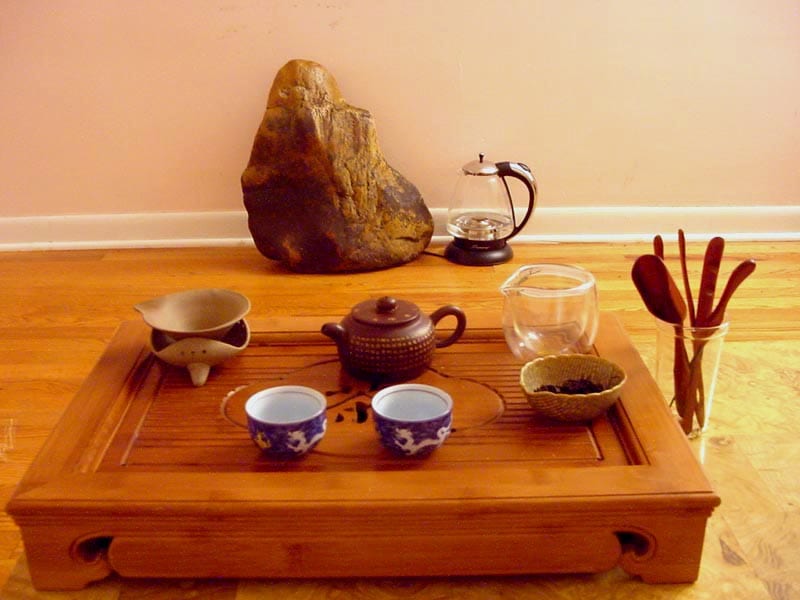
Gongfu tea emphasises vessels, hand technique and repeated short infusions. It is common in southern Fujian, Chaozhou and Taiwan. A typical setup combines a small pot or gaiwan, small cups, a pitcher and a kettle. “Gongfu” refers to time and skill, not the martial-arts association of “kung fu”; it is a tea-drinking practice that developed in particular regions, not a nationwide ancient rite.
Basic flow
Warm the vessels, add leaf, rinse if appropriate, pour short infusions and share the liquor. Adjust each infusion according to aroma and taste. A high leaf ratio means the tea must not be left to steep for long. Traditional Chaozhou gongfu tea uses a small pot and three small cups; modern households often use a gaiwan. Vessels may vary, but the core is controlling concentration and sharing the tea.
Vessels
A gaiwan makes it easy to observe the leaf and decant; a small pot holds heat better; a pitcher is used to even out the liquor; small cups suit tasting. The kettle should be able to provide water close to boiling consistently. The equipment need not be expensive; matching capacity, a clean pour and easy cleaning matter more.
Etiquette
Serving cups with both hands, offering tea to guests before the host and refilling promptly are common courtesies. Details differ between families and regions, and no single movement should be treated as the only correct form. The “etiquette” of gongfu tea is mainly about making guests feel looked after, not performing complicated gestures.
Common misconceptions
- Is gongfu tea the same as “kung fu tea”? The usual written term is gongfu cha, referring to time and skill, not martial arts.
- Must you use three small cups? No. Numbers and vessels vary; the core is serving the liquor evenly.
- Does more leaf always mean better tea? No. Too much leaf increases bitterness and waste.
- Is gongfu tea an unchanged ancient practice? No. It took shape gradually in southern Fujian, Chaozhou and Taiwan, and modern vessels and habits continue to change.
Sources
- UNESCO Intangible Cultural Heritage: Traditional tea processing techniques and associated social practices in China — Inscribed in 2022; covers tea processing, drinking and hospitality practices.
This page is an AI-edited translation based on the reviewed Chinese source. It is not a human-expert endorsement; factual claims are bounded by the listed sources.